
Distributor Appointment Services in India
Distributor Appointment Services in India
Helping Foreign Companies Appoint the Right Distributor in India
India is one of the world’s fastest-growing consumer and industrial markets, offering significant opportunities for overseas businesses across manufacturing, technology, healthcare, consumer goods, engineering, chemicals, food processing and many other sectors.
However, establishing a company in India is not always the preferred first step. Many foreign companies choose to enter the Indian market by appointing a local distributor who can introduce their products, build customer relationships and develop the market before they make a larger investment.
The distributor model enables overseas businesses to explore market opportunities with comparatively lower investment, fewer regulatory obligations and greater operational flexibility. It is often an effective strategy for companies that wish to understand customer demand, evaluate commercial viability and gradually build their presence in India.
EzyBiz India Consulting LLP offers Distributor Appointment Services as part of its India Market Entry practice. We assist foreign companies in understanding the distributor model, evaluating suitable distribution strategies, identifying potential business partners, reviewing commercial and regulatory considerations, and coordinating the appointment process.
With our experience in India market entry, foreign investment regulations, company establishment, taxation and regulatory compliance, we help businesses make informed decisions while planning their expansion into India.
Why Appoint a Distributor in India?
Entering a new market involves understanding customer behaviour, local business practices, pricing expectations, logistics, regulations and competition. India is a large and diverse market where these factors often vary across different states and regions.
A local distributor can provide valuable market access through its existing customer relationships, sales network and knowledge of the local business environment. This enables foreign companies to begin selling their products without immediately establishing their own operational presence in India.
Some of the key advantages of the distributor model include:
- Faster access to the Indian market
- Lower initial investment compared to establishing an Indian company
- Reduced administrative and regulatory responsibilities
- Access to an existing sales and distribution network
- Local market knowledge and customer relationships
- Better understanding of regional business practices
- Greater flexibility while evaluating long-term expansion plans
- Opportunity to test market demand before making larger investments
For many businesses, appointing a distributor serves as the first phase of a long-term India market entry strategy.
Is the Distributor Model Suitable for Your Business?
The distributor model may be an appropriate option if your company:
- Is entering India for the first time.
- Wishes to test market demand before making substantial investments.
- Exports products directly from its home country.
- Does not presently require a physical office or subsidiary in India.
- Wants to minimise initial setup and compliance costs.
- Plans to establish an Indian subsidiary after achieving stable business growth.
- Requires local sales support through experienced business partners.
- Wants to expand gradually while reducing commercial risk.
On the other hand, businesses that require direct control over operations, manufacturing, large-scale procurement or extensive local staffing may eventually find it more suitable to establish an Indian subsidiary or another business presence.
Selecting the right market entry strategy depends on your commercial objectives, industry, investment plans and long-term growth strategy.
Our Distributor Appointment Services
Our services are designed to assist foreign companies in evaluating and implementing the distributor model as part of their India market entry strategy.
Depending on your business requirements, we can assist with the following:
India Market Entry Consultation
We begin by understanding your business, products, target customers, industry, pricing strategy and expansion objectives. Based on these discussions, we help you evaluate whether appointing a distributor is the most suitable market entry option.
Distribution Strategy Advisory
Every business has different commercial objectives. We assist clients in evaluating various distribution models, including:
- Exclusive distribution
- Non-exclusive distribution
- National distributors
- Regional distributors
- Product-specific distributors
- Multiple distributor models
- Industry-specific distribution strategies
Assistance in Identifying Potential Distribution Partners
Based on your industry, products and target market, we assist in identifying potential distribution partners that may be suitable for your commercial requirements.
The final selection and appointment always remain the commercial decision of the client.
Commercial Evaluation Support
Selecting the right distributor involves more than reviewing sales capabilities. Businesses should also consider factors such as:
- Industry experience
- Geographic coverage
- Customer base
- Sales infrastructure
- Warehousing capabilities
- Financial stability
- Market reputation
- Product portfolio
- Management capabilities
We assist clients in developing an evaluation framework so they can make informed commercial decisions.
Distribution Agreement Support
A properly drafted distribution agreement helps define the rights and responsibilities of both parties and reduces the possibility of future disputes.
We assist clients by reviewing commercial, tax and regulatory aspects relating to distribution arrangements and coordinate with legal professionals wherever specialised legal documentation is required.
The agreement may typically address matters such as:
- Territory
- Exclusivity
- Pricing
- Payment terms
- Sales targets
- Marketing responsibilities
- Intellectual property protection
- Confidentiality
- Product warranties
- Termination
- Dispute resolution
Regulatory and Tax Advisory
Depending on the nature of products and business activities, we also advise clients on relevant Indian regulatory and tax considerations, including:
- FEMA regulations
- Import procedures
- Customs considerations
- GST implications
- BIS certification
- FSSAI registration
- Product-specific approvals
- Other applicable regulatory requirements
Why Many Foreign Companies Prefer the Distributor Model
For businesses exploring opportunities in India, appointing a distributor can provide a practical balance between market access and investment.
Compared with establishing a legal entity in India, the distributor model generally offers:
- Lower upfront investment
- Faster market entry
- Reduced compliance obligations
- Greater operational flexibility
- Lower ongoing administrative costs
- Opportunity to understand customer preferences
- Ability to evaluate long-term business potential before expanding further
As business volumes grow, many companies subsequently establish a wholly owned subsidiary, branch office or other business presence in India while continuing to work with selected distributors.
Our Advisory Approach
At EzyBiz India Consulting LLP, our objective is to help foreign companies evaluate the most appropriate route for entering the Indian market. Depending on your business objectives, we can assist you in understanding the distributor model, assessing commercial considerations, coordinating with relevant professionals where required, and integrating distributor appointment into your broader India market entry strategy.
Choosing the right distribution partner is ultimately a commercial decision. Our role is to provide independent advisory support that helps clients make informed decisions based on their business goals, regulatory requirements and long-term expansion plans.
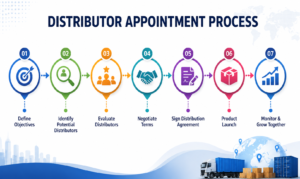
Our Step-by-Step Distributor Appointment Process
Appointing the right distributor requires careful planning and evaluation. A wrong appointment can result in poor sales performance, customer dissatisfaction, brand dilution and contractual disputes. We recommend following a structured process before entering into any long-term distribution arrangement.
Step 1 – Understand Your Market Entry Objectives
Before searching for a distributor, it is important to clearly define your objectives, such as:
- Target customers
- Geographic markets
- Product positioning
- Expected sales volumes
- Pricing strategy
- Marketing approach
- Long-term expansion plans
A clear strategy helps identify the type of distributor that best aligns with your business goals.
Step 2 – Determine the Appropriate Distribution Model
Different businesses require different distribution models. Factors such as product type, industry, customer profile and after-sales support requirements influence the most suitable structure.
Common options include:
- Exclusive Distributor
- Non-Exclusive Distributor
- National Distributor
- Regional Distributor
- Multiple Distributors
- Industry-Specific Distributor
Choosing the right model at the outset can significantly improve long-term business performance.
Step 3 – Identify Potential Distribution Partners
Potential distributors may be identified through:
- Industry associations
- Trade fairs and exhibitions
- Business networks
- Chambers of commerce
- Industry directories
- Market research
- Professional referrals
At this stage, businesses should prepare an initial shortlist based on relevant industry experience and market presence.
Step 4 – Evaluate the Distributor
Before making any appointment, businesses should evaluate factors such as:
- Industry experience
- Existing customer relationships
- Geographic coverage
- Product portfolio
- Sales capabilities
- Warehousing facilities
- Service infrastructure
- Financial strength
- Business reputation
- Long-term growth potential
Selecting a distributor solely on the basis of size or turnover may not always be the best commercial decision.
Step 5 – Negotiate Commercial Terms
Important commercial issues should be discussed before finalising the relationship, including:
- Territory
- Product range
- Pricing
- Payment terms
- Credit limits
- Sales targets
- Marketing responsibilities
- Inventory management
- Reporting requirements
- Technical support
- Training
Clear commercial expectations reduce misunderstandings later.
Step 6 – Execute a Well-Drafted Distribution Agreement
A comprehensive agreement should clearly define the rights and obligations of both parties.
Important clauses generally include:
- Scope of appointment
- Territory
- Exclusivity
- Product pricing
- Intellectual property
- Confidentiality
- Minimum purchase obligations
- Performance review
- Renewal
- Termination
- Governing law
- Dispute resolution
Professional legal advice should always be obtained before signing any agreement.
Step 7 – Monitor Performance
The relationship should be reviewed periodically by monitoring:
- Sales performance
- Customer feedback
- Market coverage
- Inventory levels
- Payment discipline
- Marketing activities
- Achievement of agreed targets
Regular reviews help ensure that the distribution arrangement continues to support the company’s business objectives.
Need Help Finding the Right Distributor in India?
Every business requires a different market entry strategy. Our India Market Entry specialists can help you evaluate whether appointing a distributor is the right approach for your business.
Schedule a Consultation Today
Types of Distribution Models
No single distribution model is suitable for every business. The most appropriate structure depends on the nature of the products, target customers and long-term expansion plans.
Exclusive Distributor
An exclusive distributor receives the exclusive right to sell products within a specified territory.
Advantages
- Strong distributor commitment
- Better investment in marketing
- Improved brand positioning
- Simplified channel management
Considerations
- Dependence on one distributor
- Limited flexibility
- More difficult to replace if performance is unsatisfactory
Non-Exclusive Distributor
Multiple distributors are appointed within the same territory.
Advantages
- Wider market coverage
- Reduced dependency
- Competitive sales environment
- Greater flexibility
Considerations
- Potential pricing conflicts
- Channel management becomes more complex
National Distributor
A single distributor manages sales throughout India.
This model may be suitable where:
- Product demand is concentrated.
- Centralised management is preferred.
- Product range is limited.
Regional Distributor
Different distributors are appointed for different regions of India.
Considering India’s size and regional diversity, this model is often preferred for businesses seeking broader market penetration.
Distributor vs Dealer vs Agent vs Sales Representative
These terms are often used interchangeably, but they have different commercial implications.
| Model | Purchases Goods | Owns Inventory | Earns |
|---|---|---|---|
| Distributor | Yes | Yes | Profit Margin |
| Dealer | Yes | Yes | Profit Margin |
| Agent | No | No | Commission |
| Sales Representative | Usually No | No | Salary / Commission |
Choosing the appropriate business model depends on the company’s commercial strategy, pricing structure and desired level of control.
Factors to Consider Before Appointing a Distributor
Before finalising any appointment, businesses should carefully evaluate:
- Industry experience
- Financial stability
- Existing customer network
- Geographic coverage
- Technical capabilities
- After-sales support
- Warehousing facilities
- Product compatibility
- Market reputation
- Business ethics
- Digital capabilities
- Growth potential
A structured evaluation process helps minimise commercial risk.
Common Challenges Faced by Foreign Companies
Foreign businesses entering India frequently encounter challenges such as:
- Difficulty identifying reliable distributors
- Limited visibility into the distributor’s actual market reach
- Cultural and communication differences
- Pricing expectations
- Credit management
- Territory disputes
- Parallel imports
- Brand protection
- Intellectual property concerns
- Performance monitoring
- Contract enforcement
Recognising these issues early allows businesses to establish appropriate commercial safeguards.
Legal and Regulatory Considerations
Although appointing a distributor generally involves fewer regulatory requirements than establishing a company, businesses should still consider several legal and commercial aspects.
Depending on the industry and products involved, relevant considerations may include:
- FEMA regulations
- Import and customs procedures
- GST implications
- Product registration requirements
- BIS certification
- FSSAI licensing
- Sector-specific approvals
- Intellectual property protection
- Trademark registration
- Competition law considerations
Seeking professional advice before entering into distribution arrangements can help reduce legal and commercial risks.
Why Choose EzyBiz India Consulting LLP?
Expanding into India involves more than simply identifying a distributor. Foreign companies must also consider regulatory requirements, taxation, import procedures, contractual arrangements, intellectual property protection and long-term expansion plans.
EzyBiz India Consulting LLP provides integrated advisory services to help foreign businesses evaluate and implement the most suitable India market entry strategy.
Our multidisciplinary team advises clients on various aspects of doing business in India, including:
- India Market Entry Strategy
- Foreign Direct Investment (FDI)
- FEMA and RBI Regulations
- Company Incorporation
- Wholly Owned Subsidiary
- Joint Venture Advisory
- Branch Office,
- Liaison Office and
- Project Office
- Tax Advisory
- GST Advisory
- Regulatory Compliance
- Accounting and Payroll Support
- Virtual CFO Services
Whether you choose to appoint a distributor initially or establish a business presence in India, we can assist you in planning a practical and compliant market entry strategy.
From Distributor to Long-Term Business Expansion
Many successful international companies follow a phased approach while entering India.
A typical business expansion journey may look like this:
Phase 1 – Market Assessment
Understand customer demand, competition, pricing and regulatory requirements.
↓
Phase 2 – Appoint an Indian Distributor
Begin selling products through an established distribution network with relatively lower investment.
↓
Phase 3 – Build Market Presence
Increase sales, strengthen customer relationships and evaluate long-term opportunities.
↓
Phase 4 – Establish an Indian Entity
Depending on business growth, establish a:
↓
Phase 5 – Expand Operations
Set up local teams, warehousing, manufacturing or research facilities to support long-term growth in India.
This phased approach allows businesses to reduce initial risk while creating a scalable foundation for future expansion.
Start Your India Market Entry Journey with Confidence
Disclaimer
The information provided on this page is intended for general informational purposes only and should not be construed as legal, tax or investment advice. Every business expansion involves unique commercial, regulatory and tax considerations that should be evaluated based on the specific facts and circumstances.
EzyBiz India Consulting LLP provides advisory services relating to India market entry, regulatory compliance and business structuring. Where specialised legal or other professional assistance is required, we coordinate with qualified professionals to help clients implement appropriate solutions.
Before making any investment or commercial decision relating to India, businesses should obtain professional advice based on their particular requirements.
Related India Market Entry Services
Establishing a business in India often involves several legal, regulatory and commercial considerations beyond company incorporation. Depending on your business objectives, you may also find the following services useful:
- India Market Entry Services – Comprehensive advisory for foreign businesses planning to establish or expand operations in India.
- Business Setup in India – End-to-end assistance for selecting the appropriate business structure and completing the incorporation process.
- Foreign Company Registration in India – Registration and regulatory support for overseas companies entering the Indian market.
- Wholly Owned Subsidiary in India – Assistance with establishing a wholly owned Indian subsidiary under the applicable FDI framework.
- Joint Venture in India – Structuring and implementing strategic partnerships with Indian businesses.
- Branch Office in India – Advisory and registration support for overseas companies establishing a branch office.
- Liaison Office in India – Assistance in setting up a liaison office for market research and business promotion activities.
- Project Office in India – Registration and compliance support for project-specific business operations.
- India Market Entry Services by Country – Explore our country-specific India market entry guides designed for businesses from different jurisdictions.
If you are uncertain about the most suitable structure for your business, our India Entry specialists can help you evaluate the available options and recommend the most appropriate strategy based on your commercial objectives and the applicable regulatory framework.
Ready to Expand Your Business into India?
Every business has unique commercial objectives, investment plans and regulatory considerations. Selecting the right market entry strategy requires careful evaluation of legal, tax and commercial factors.
Whether you are considering appointing a distributor, establishing a subsidiary or exploring other expansion options, our team can help you understand the available alternatives and develop an approach that aligns with your long-term business goals.
Schedule a Consultation with Our India Market Entry Specialists Today.
If your organisation is considering expansion into India, we would be pleased to discuss your business objectives and recommend the most suitable market entry strategy.
Contact us today to schedule a consultation and take the first step towards establishing your business in India with confidence.
Explore our India Market Entry Services by Country to learn about investment opportunities, business setup and regulatory guidance for companies from Taiwan, China, Germany, the USA and other countries.
Distributor Appointment Services in India
Frequently Asked Questions (FAQs)
1. Can a foreign company appoint a distributor in India without establishing an Indian company?
Yes. Many foreign companies export products directly to Indian distributors without incorporating a legal entity in India. The appropriate structure depends on the nature of the business, products and long-term objectives.
2. Is appointing a distributor better than incorporating a subsidiary?
It depends on your business goals. If you wish to test the Indian market with lower investment, a distributor or Liaison office may be an appropriate starting point. If you require greater operational control, local employees or manufacturing facilities, establishing an Indian company may be more suitable.
3. How do I choose the right distributor?
Businesses should evaluate factors such as industry experience, customer network, financial stability, infrastructure, technical capabilities, reputation and long-term business compatibility before making an appointment.
4. Should I appoint one distributor or multiple distributors?
There is no single answer. Some businesses prefer a national distributor, while others appoint regional distributors to achieve wider market coverage. The appropriate model depends on the products, industry and commercial strategy.
5. Should I appoint an exclusive distributor?
Exclusive arrangements can encourage greater commitment but also increase dependence on a single business partner. The decision should be based on commercial objectives and performance expectations.
6. Do I need a distribution agreement?
Yes. A properly drafted agreement helps clearly define the rights and obligations of both parties and reduces the risk of future disputes.
7. What taxes should foreign companies consider while appointing a distributor?
Depending on the transaction structure, businesses may need to consider customs duties, GST, transfer pricing (where applicable), withholding tax and other Indian tax implications. Professional advice should be obtained before finalising commercial arrangements.
8. Can EzyBiz India help us if we later decide to establish a company in India?
Yes. In addition to distributor appointment advisory, we assist foreign companies with company incorporation, FEMA compliance, RBI regulations, taxation, accounting, payroll and ongoing regulatory compliance.
Still have questions about expanding your business into India? Contact our India Entry specialists for personalised guidance tailored to your business objectives and country of origin.
Country-Specific India Market Entry Pages
We have prepared dedicated India market entry pages to help overseas businesses understand the regulatory, tax and commercial considerations applicable to their jurisdiction. Explore our country-specific guides below:
- India Market Entry Services for Chinese Companies
- India Market Entry Services for Taiwanese Companies
- India Market Entry Services for US Companies
- India Market Entry Services for UK Companies
- India Market Entry Services for Australian Companies
- India Market Entry Services for German Companies
- India Market Entry Services for Japanese Companies
- India Market Entry Services for Singapore Companies
- India Market Entry Services for UAE Companies
Related India Entry Services
Prepared by EzyBiz India Consulting LLP
- Reviewed by Anil Agrawal, Chartered Accountant
- 20+ years of experience in FEMA, FDI, International Tax and India Market Entry Advisory.
EzyBiz India Consulting LLP is a multidisciplinary advisory firm specializing in India Market Entry, Corporate Finance, Tax & Regulatory Advisory and Business Support Services for foreign companies and growing businesses.
Last Updated: July 2026
Disclaimer
This page provides general information regarding India’s foreign investment framework for global companies. Regulatory requirements, including the FDI Policy, Government approval process, FEMA regulations and tax laws, may change over time. The applicability of these regulations depends on the specific facts and ownership structure of each investment. Professional advice should be obtained before making any investment or business decision.